Understanding AI
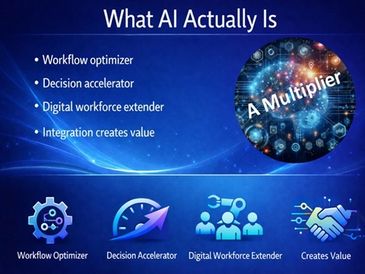
What AI Is
What AI Is Not
AI is a set of technologies that can analyze information, identify patterns, and support action. In the realm of business AI transformation, AI tools for business are particularly valuable when they enhance workflows and empower people to make informed decisions more swiftly while collaborating with them.
However, AI opportunities do no
AI is a set of technologies that can analyze information, identify patterns, and support action. In the realm of business AI transformation, AI tools for business are particularly valuable when they enhance workflows and empower people to make informed decisions more swiftly while collaborating with them.
However, AI opportunities do not create value independently. True value arises from effectively aligning AI with people, processes, data, governance, and business goals.
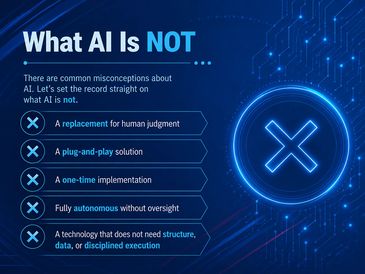
What AI Is Not
What AI Is Not
AI offers numerous opportunities to enhance work, but it is not a complete solution on its own. Achieving strong results requires a thoughtful strategy, context, quality information, governance, and people involved in the process.
It’s important to understand that AI is not a business strategy itself.
AI should not be viewed as a repla
AI offers numerous opportunities to enhance work, but it is not a complete solution on its own. Achieving strong results requires a thoughtful strategy, context, quality information, governance, and people involved in the process.
It’s important to understand that AI is not a business strategy itself.
AI should not be viewed as a replacement for people.
AI tools for business are not automatically accurate.
AI is not effective without quality data.
Lastly, adopting business AI transformation is not a one-time project.
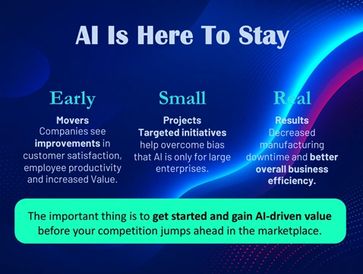
AI Is Already Creating Practical Value
AI Is Already Creating Practical Value
AI opportunities are already helping organizations enhance their everyday work. Focused projects utilizing AI tools for business can significantly reduce manual effort, improve information flow, and support faster decisions. The strongest results in business AI transformation occur when AI is aligned with organizational needs, people, processes, and governance.
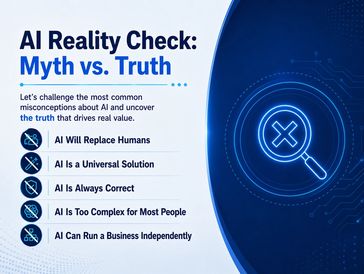
AI Reality Check, Myth vs. Truth
Myth 2: AI Is A Universal Solution or Magic Wand
AI Is Already Creating Practical Value
Myth: AI works on its own. Truth: AI needs clear goals, data, and oversight to unlock its full potential. While AI may seem like it could replace human judgment, the reality is that AI supports people by providing valuable information. The journey of business AI transformation begins with identifying business needs and the right AI tools
Myth: AI works on its own. Truth: AI needs clear goals, data, and oversight to unlock its full potential. While AI may seem like it could replace human judgment, the reality is that AI supports people by providing valuable information. The journey of business AI transformation begins with identifying business needs and the right AI tools for business processes. It’s important to understand that the value of AI does not happen instantly; rather, it grows through adoption and effective governance to truly realize the AI opportunities available.
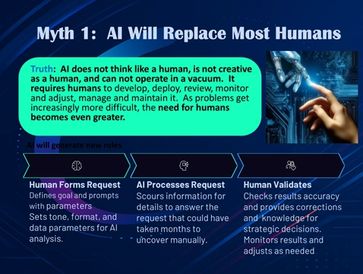
Myth: AI will take over most work.
Myth 2: AI Is A Universal Solution or Magic Wand
Myth 2: AI Is A Universal Solution or Magic Wand
Truth: While AI tools for business are transforming how work gets done, people remain essential. AI opportunities may automate tasks and reshape roles, but it is people who define goals, provide context, exercise judgment, manage exceptions, collaborate, lead, and remain accountable for outcomes in this business AI transformation.
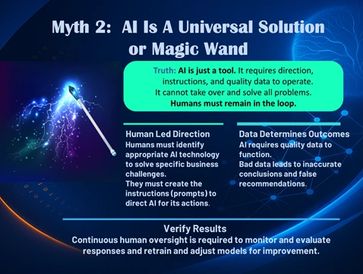
Myth 2: AI Is A Universal Solution or Magic Wand
Myth 2: AI Is A Universal Solution or Magic Wand
Myth 2: AI Is A Universal Solution or Magic Wand
Truth: AI is a tool whose value depends on business needs, process fit, data, governance, and adoption. To fully leverage AI opportunities, organizations must recognize how AI tools for business can address their specific requirements. AI creates value when people define the business need, guide its use, provide usable data, verify outcom
Truth: AI is a tool whose value depends on business needs, process fit, data, governance, and adoption. To fully leverage AI opportunities, organizations must recognize how AI tools for business can address their specific requirements. AI creates value when people define the business need, guide its use, provide usable data, verify outcomes, and adjust continuously, facilitating an effective business AI transformation.
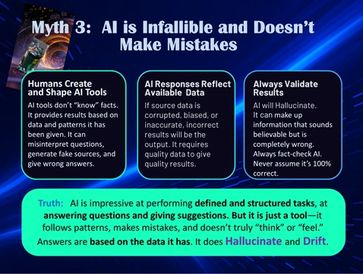
Myth 3: AI is Infallible and Doesn’t Make Mistakes
Myth 4: Too Complex for Most People. You Need A PhD To Benefit From AI
Myth 4: Too Complex for Most People. You Need A PhD To Benefit From AI
Truth: While AI tools for business present numerous opportunities, they can also produce inaccurate, biased, incomplete, hallucinated, or drifting outputs. Therefore, before these AI outputs inform decisions or actions, it is crucial for individuals to review them, validate against trusted information, add context, monitor results, and re
Truth: While AI tools for business present numerous opportunities, they can also produce inaccurate, biased, incomplete, hallucinated, or drifting outputs. Therefore, before these AI outputs inform decisions or actions, it is crucial for individuals to review them, validate against trusted information, add context, monitor results, and remain accountable in the journey of business AI transformation.
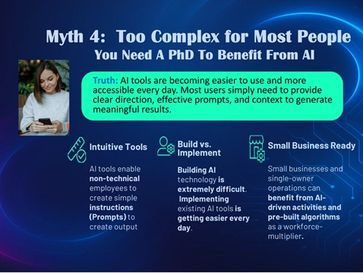
Myth 4: Too Complex for Most People. You Need A PhD To Benefit From AI
Myth 4: Too Complex for Most People. You Need A PhD To Benefit From AI
Myth 4: Too Complex for Most People. You Need A PhD To Benefit From AI
Truth: Nontechnical people can benefit from AI opportunities through practical training and clear context. AI tools for business empower non-technical individuals.
Practical, role-based AI training builds the knowledge, skills, context, and confidence employees need to use AI effectively and responsibly, facilitating successful business AI transformation.
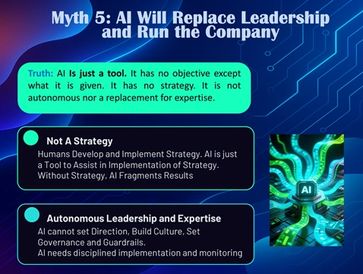
Myth 5: AI Will Replace Leadership and Run the Company
Myth 4: Too Complex for Most People. You Need A PhD To Benefit From AI
Myth 5: AI Will Replace Leadership and Run the Company
Truth: AI tools for business can support analysis, insight, planning, and execution, but they cannot run a company. Leaders are essential for steering direction, maintaining decision authority, and ensuring accountability and responsibility for outcomes amid the ongoing business AI transformation.